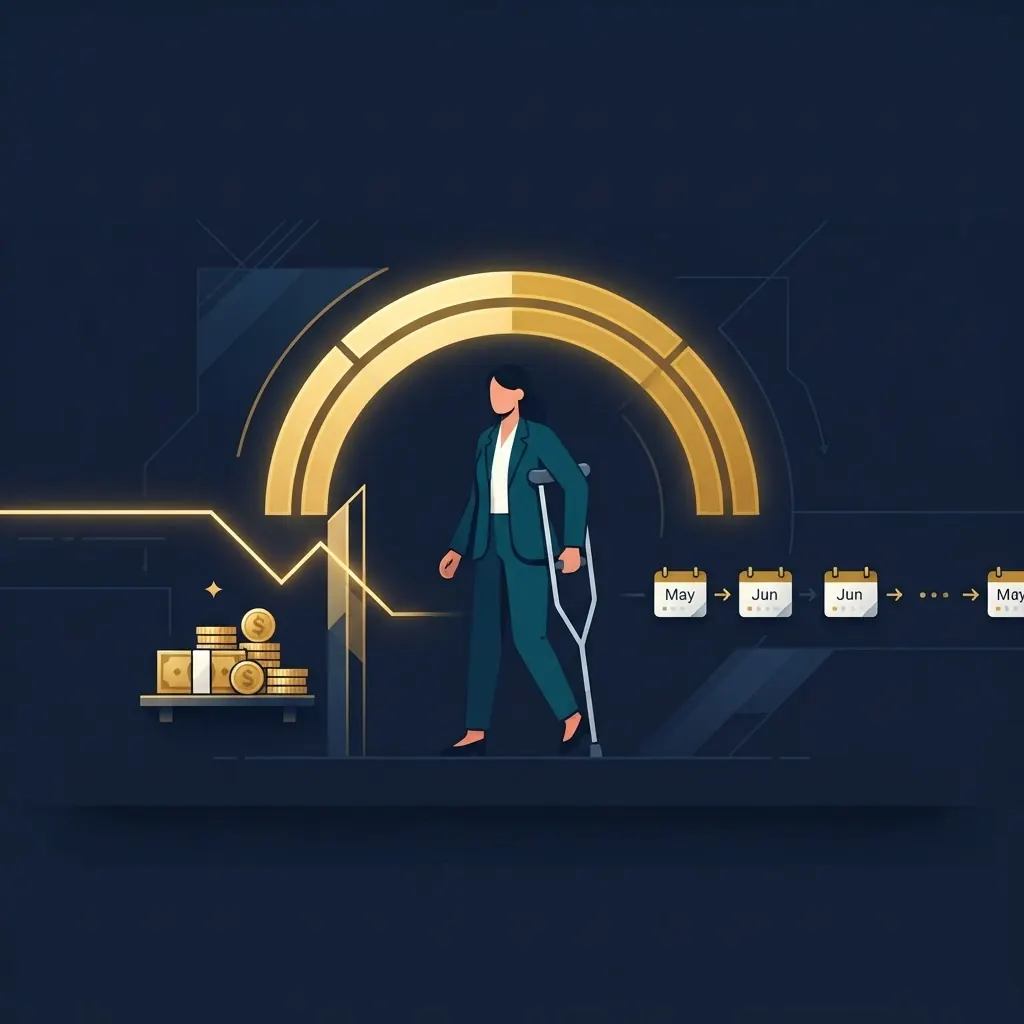
Disability insurance is a policy that replaces lost income if an illness or injury prevents an individual from working. Policies typically replace roughly 50% to 70% of earned income, costing about 1% to 3% of annual earnings. Employer-provided plans often cap payouts and end with employment, whereas individual own-occupation policies provide portable, specialty-specific protection. Below, we detail short-term versus long-term options, own-occupation definitions, cost breakdowns, and policy evaluation steps.
Ask a room full of working adults whether they have life insurance, and a good number will say yes. Ask the same room whether they have disability insurance, and the number drops sharply — often to almost nobody outside of what an employer might provide automatically. This is backwards from how the actual risk breaks down. Over the course of a career, the odds of a long-term disability that stops you from working are notably higher than the odds of dying during your working years, yet disability insurance gets a fraction of the attention.
At a Glance: Disability Insurance Options (2026)
| Factor | Short-Term Disability (STD) | Long-Term Disability (LTD) |
|---|---|---|
| Income Replacement | Typically replaces 50% to 70% of gross earnings | Typically replaces 50% to 70% of pre-disability income |
| Benefit Duration | A few weeks up to roughly 6 months | Several years, or until reaching retirement age |
| Waiting Period | Often 0 to 14 days after injury or illness | Often 90 to 180 days before benefits commence |
| Typical Premium Cost | Frequently provided by employers | Costs roughly 1% to 3% of annual income for individual plans |
| Occupation Definition | Covers short recovery from temporary conditions | Features "own-occupation" or stricter "any-occupation" definitions |
| Common Plan Gaps | Ends after short recovery period | Group plans often cap benefits, taxed if employer-paid |
What disability insurance actually replaces
Disability insurance replaces a portion of your income — typically 50–70% — if you become unable to work due to an illness or injury. This isn't limited to catastrophic accidents; the leading causes of long-term disability claims are actually things like back injuries, cancer, and other chronic illnesses that gradually or suddenly make a person's usual job impossible to perform, not the dramatic accident scenarios people tend to picture when they think about disability.
Short-term vs. long-term disability
| Short-Term Disability | Long-Term Disability | |
|---|---|---|
| Typical duration | A few weeks up to about 6 months | Several years, sometimes until retirement age, depending on the policy |
| Waiting period before benefits start | Often 0-14 days | Often 90-180 days (sometimes bridged by short-term coverage) |
| Common source | Often provided by employers, sometimes state-mandated in certain states | Less commonly provided by employers at a meaningful level; often needs individual coverage |
| What it's designed for | Shorter recoveries — surgery, a difficult pregnancy, a temporary injury | Serious, extended, or permanent conditions that keep you out of work for years |
"Own occupation" vs. "any occupation" — the definition that decides your claim
This is the single most important clause to understand in a disability policy, and it's often buried in language most people skim past. An "own occupation" policy pays out if you can't perform the specific duties of your own job or specialty — a surgeon who develops a hand tremor and can no longer operate, for example, could still claim benefits under an own-occupation policy even if they could theoretically do some other kind of work. An "any occupation" policy only pays out if you can't perform any job reasonably suited to your education and experience — a much higher bar to meet, and far more restrictive in practice.
Own-occupation policies cost more, but for professionals whose income depends heavily on a specific physical or specialized skill, the difference in protection can be significant. It's worth explicitly checking which definition your policy uses rather than assuming.
Who needs individual disability coverage most
- Self-employed people and freelancers, who have no employer-provided coverage at all by default and need to build this protection from scratch.
- High earners, whose employer group policy's coverage cap likely replaces a much smaller percentage of their actual income than the plan's headline percentage suggests.
- People in physically demanding or highly specialized professions, where an own-occupation definition matters more and group coverage terms are often less favorable.
- Sole or primary household earners, where a lost income stream has an outsized impact on the household's financial stability.
What it typically costs
Individual long-term disability premiums are often estimated as roughly 1–3% of your annual income, though this varies with age, health, occupation risk category, and the specific policy terms. For many people, that's a meaningfully smaller expense than they assume, especially relative to the income it's protecting.
What to check before buying or relying on employer coverage
- What percentage of your actual current income would the policy replace, and is there a dollar cap that reduces that percentage for your income level?
- Does it use an own-occupation or any-occupation definition of disability?
- How long is the waiting period before benefits begin, and do you have enough emergency savings to bridge that gap?
- How long do benefits last once approved — a few years, or until a specified retirement age?
- Is the policy portable if you leave your current employer, or does coverage end with the job (as most group employer plans do)?
Life insurance protects your family from the financial impact of your death. Disability insurance protects you and your family from the financial impact of your ongoing life — and for most working adults, that's actually the more statistically likely risk to plan around.
A simple starting approach
If you have employer-provided long-term disability coverage, start by finding out the actual percentage and dollar cap it provides — most employees have never actually looked at this detail. If there's a meaningful gap between that and your real income needs, or if you're self-employed with no coverage at all, get a quote for an individual policy and compare the own-occupation vs any-occupation terms carefully before deciding.
It's not the most exciting insurance conversation to have with yourself, but it protects against the more statistically likely version of "what if I couldn't work" — which makes it worth at least as much attention as the life insurance conversation most people have already had.
Frequently Asked Questions: Disability Insurance
What is the difference between short-term and long-term disability insurance?
Short-term coverage replaces income for a few weeks to a few months, usually after a short waiting period. Long-term coverage can pay for years, sometimes to retirement, for serious conditions.
Doesn't workers' compensation already cover me?
Only for injuries and illnesses caused by your job. If you get sick or injured off the clock, workers' compensation pays nothing, which is exactly the gap disability insurance fills.
How much disability coverage do I need?
A common target is 60 to 70 percent of your after-tax income, since disability benefits are often partially or fully tax-free depending on how premiums were paid.
Is employer-provided disability coverage enough?
Group coverage typically replaces about 60 percent of base salary only, and benefits are taxable if the employer paid the premiums. Individual, portable coverage fills the gap and stays with you between jobs.
Sources
- National Association of Insurance Commissioners (NAIC) — consumer guides and insurance industry data.
- Your state insurance department — state-specific rules, rate filings, and license verification.
- Federal Trade Commission (FTC) — consumer protection guidance.
Sources reflect the primary references used to research this guide. Always confirm state-specific rules with your own insurance department.